A club-native platform
BUILT TO ADDRESS THE TOUGHEST QUESTIONS teams face.
What gaps in roles and skills exist in our roster?
What playing style actually wins with our personnel?
Will a specific player we are interested in fit our system?
how much better will the team actually become?
What will be the impact on team chemistry?
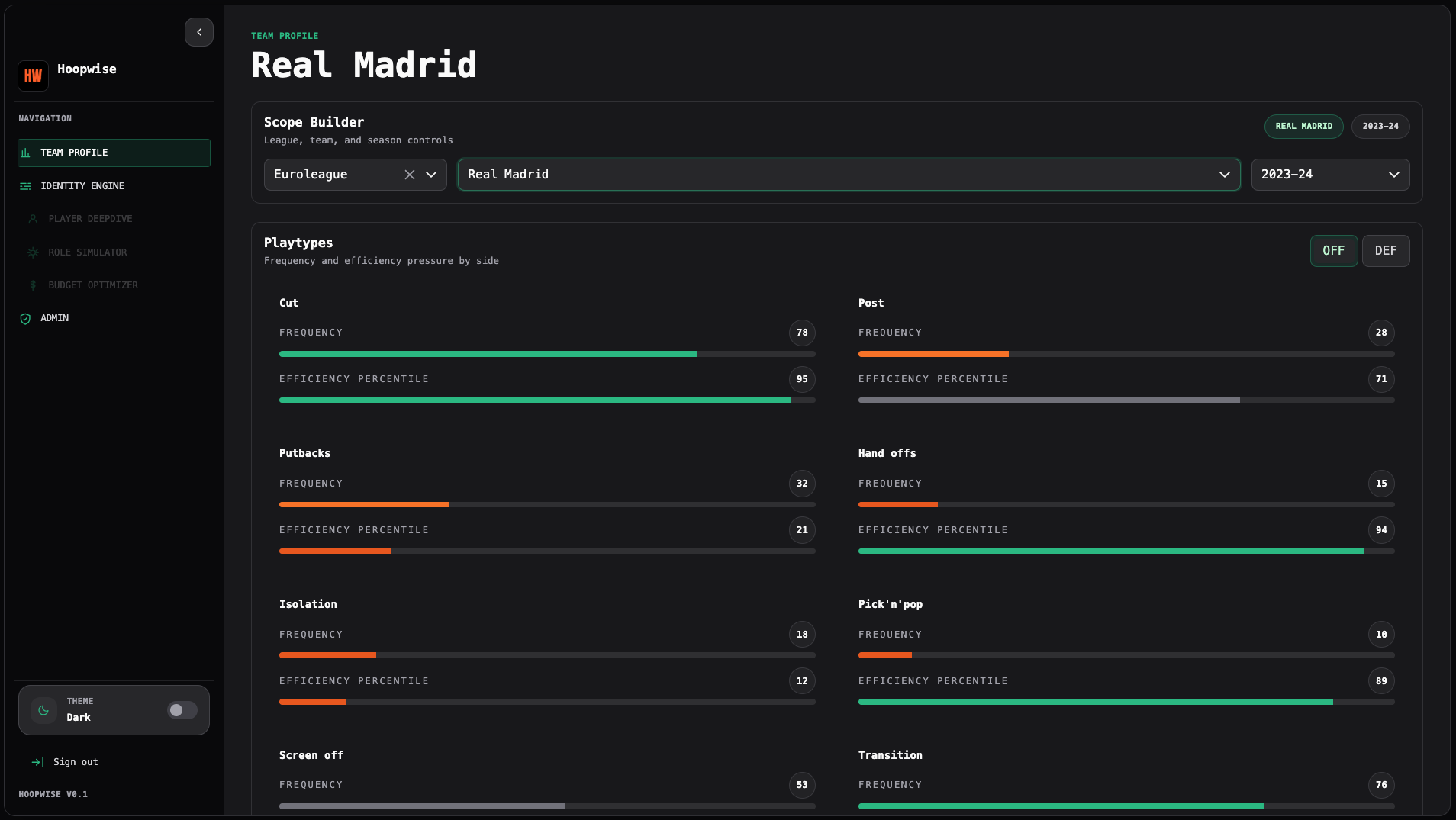
HoopWise democratizes roster construction intelligence.
FROM TODAY’S FRAGMENTED workflow
Teams may or may not have in-house analytics capacity.
If they don’t, they rely on external scouting agencies or consultants.
Even with premium data access, interpretation is often manual and inconsistent.
Outputs are report-heavy, point-in-time, and hard to iterate as the market moves.
to
A FUTURE WITH the HOOPWISE platform
Teams encode playstyle goals, tactical priorities, and constraints in one place.
HoopWise turns that input into team-specific modeling, fit signals, and scenario outputs.
Staff can re-run simulations as targets change and roster moves happen.
Decisions become repeatable workflows, not one-off reports.

Your system is the starting point, not an afterthought
Before evaluating a single candidate, HoopWise maps your team's archetype coverage, playstyle identity, and the tactical headroom your current roster already provides. What you actually need — and what you're already leaving on the table — becomes the baseline every player is measured against. Not a template. Your specific context.
Three signals, each asking a different question
We run every candidate through three distinct lenses: how well their playtype profile fits your system, whether lineups with them tend to win in environments like yours, and how their presence would historically change the output of the players already in your rotation. Each signal is independent. Together, they tell you whether a player fits, wins, and belongs — in that order.


Every score comes with its reasoning
You see not just the number but the specific playtypes, lineup combinations, and teammate interactions behind it. Risk flags surface when a player's track record carries concerns — pace mismatch, opponent quality bias, small sample. The decision stays yours. We make sure it's never made blind.