NICK CALATHES AT PAOK. WILL IT GO WELL?
A DEEPER VIEW IN CALATHES’ PERFORMANCE AT PARTIZAN PRE AND POST THE OBRADOVIC DEPARTURE, AND WHAT CAN WE TAKE AWAY WITH REGARDS TO TRINCHIERI’S SYSTEM
Nick Calathes has signed with PAOK. Andrea Trinchieri, fresh from two seasons at Žalgiris Kaunas, is the new head coach. On paper, this is a meeting of two serious European basketball professionals: a veteran playmaker with a EuroLeague title and decades of high-level experience, and a tactically demanding coach with a clear, repeatable system identity.
The question worth asking before a single game is played is not whether Calathes still has enough left. It is whether Trinchieri's system will be built to use him. To answer that, we need to go back to what happened at Partizan this past season because it is the most instructive data point available on what Calathes looks like when a system fits him, and what he looks like when it does not.
Nick Calathes joined Partizan mid-season (2025–26 EuroLeague) after a short stint at Monaco. Under Obradović, Partizan went 1W–5L in the 6 games Calathes was on the roster. The breaking point came with a convincing 69–91 loss at Panathinaikos' court, after which Obradović departed. Post-coaching change, Partizan went 12W–13L across 25 games. The sample size caveat applies to the 6-game Obradović period, but the shift in Calathes' role and the team's offensive profile is striking.
Calathes: From Passenger to Playmaker
A modest USG% bump (5.8% → 6.8%) understates what happened. Under Obradović, Calathes was barely involved. Shooting 11.6% from the field on 3.8 FGA with just 1.7 assists per game. Post-change, he became the team's primary facilitator:
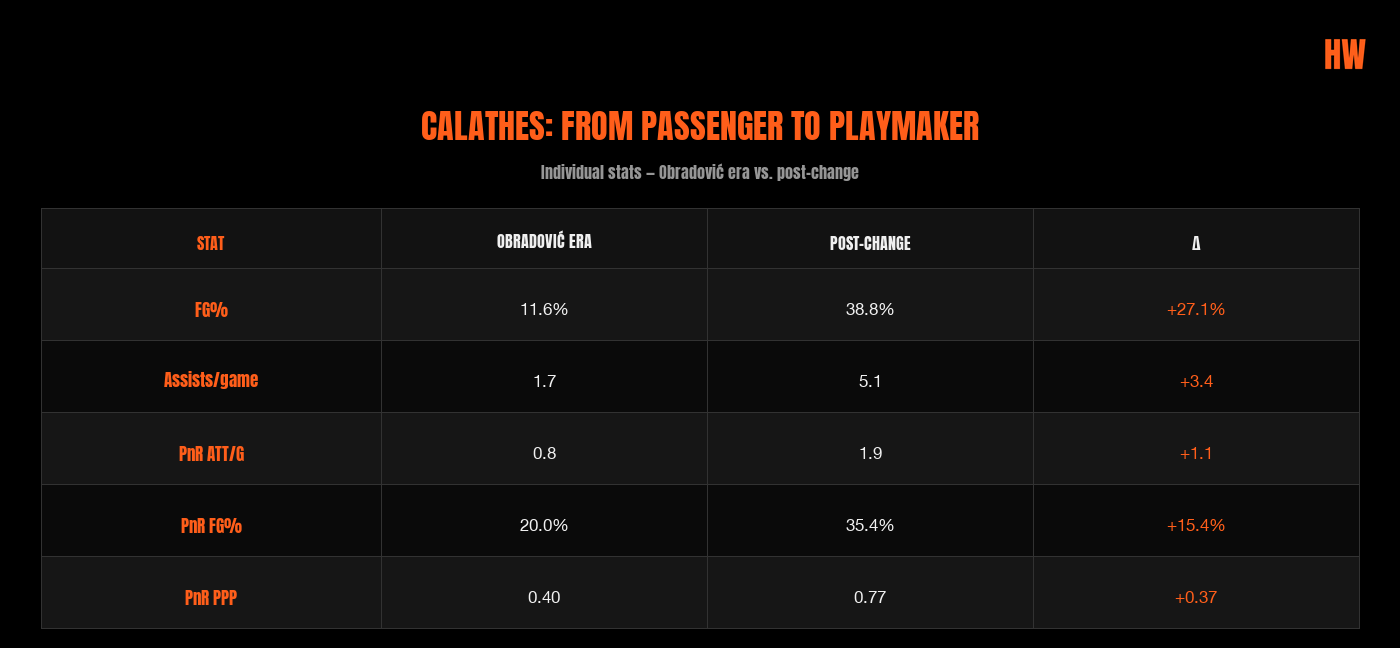
His pick-and-roll usage doubled and his efficiency across the board jumped. This wasn't just more freedom, it was a system that actually ran more and more through him.
Team Performance With Calathes On Court
The clearest measure of the coaching change's impact is how the team performed when Calathes was on the floor:
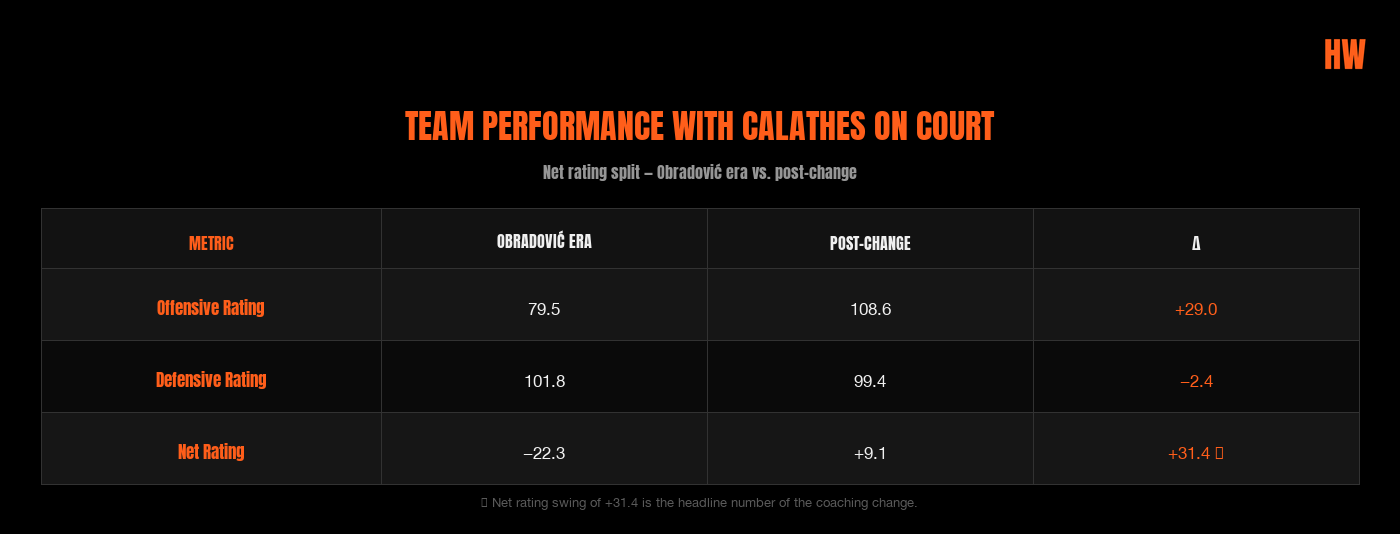
Under Obradović, Partizan's offense produced a dismal 79.5 points per 100 possessions with Calathes on the floor. Post-change: 108.6, a +29 point jump in offensive rating. The defense barely changed (~101 → ~99 DRTG). The entire transformation was offensive.
The net rating swing of +31.4 tells the story: same player, same teammates, completely different output once the system was built to use him.
Playtype Shifts: Where the Game Changed
Three playtype changes define the post-Obradović identity:
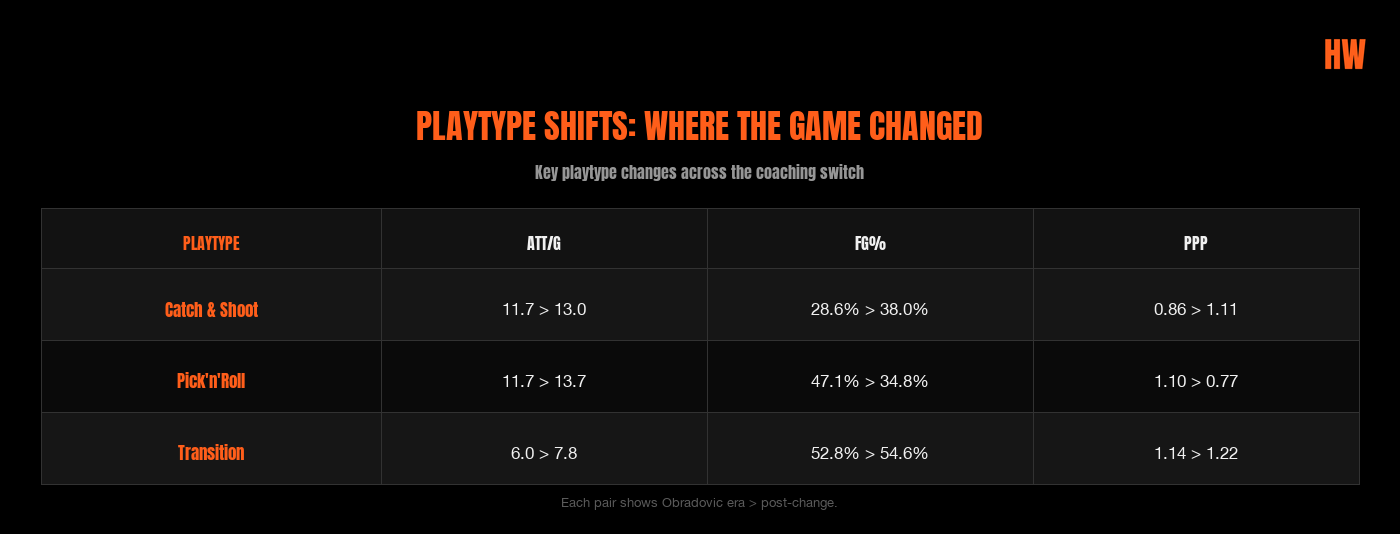
Partizan’s pre and post Obradovic coaching change
Catch & Shoot became elite, more volume AND drastically better efficiency (+9.4% FG, +0.25 PPP). A playmaker like Calathes creating open looks off the PnR feeds this directly.
Pick'n'Roll volume increased but efficiency dropped significantly. More creators running PnR (including an aging Calathes) means more possessions but less selective shot-taking.
Transition got faster and more frequent (+1.8 ATT/G), matching the overall uptempo shift. Efficiency stayed strong.
Deep Dive: The PnR Paradox
On the surface, Partizan's PnR efficiency cratered (1.10 → 0.77 PPP). But the real story is about personnel, not scheme.
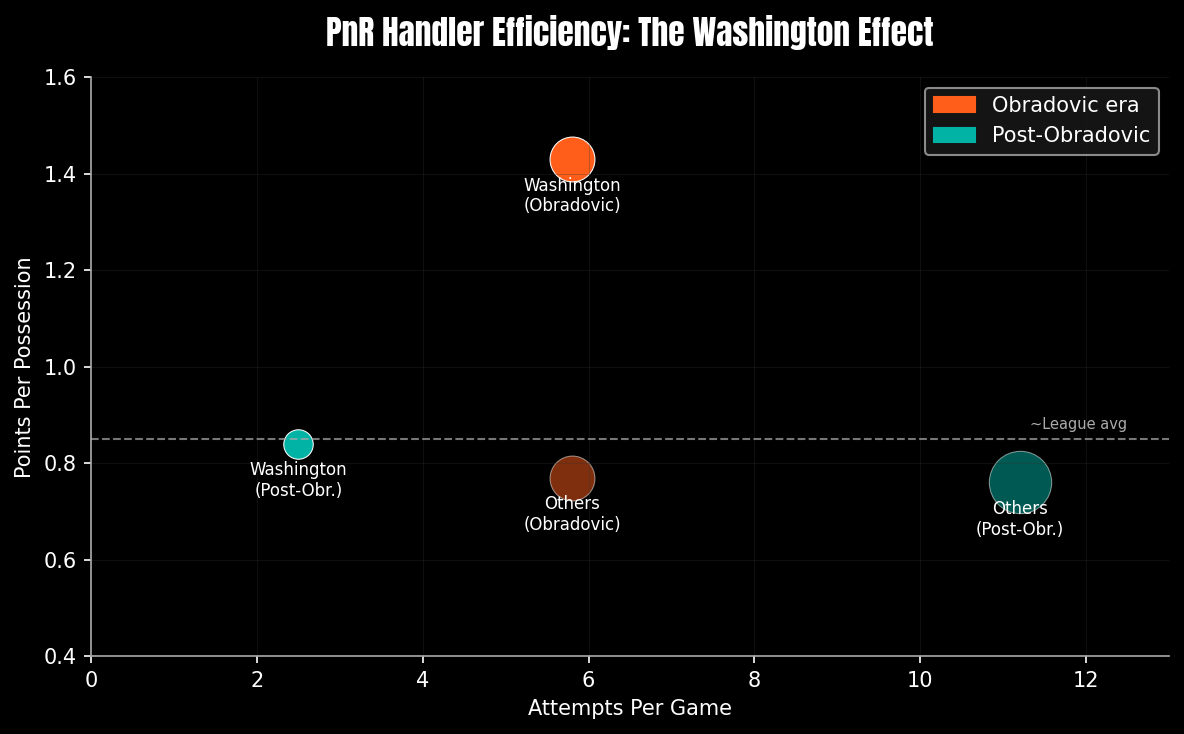
The Washington effect: Under Obradović, Duane Washington Jr. was a PnR finishing machine
Washington accounted for half the team's PnR volume under Obradović at elite efficiency. He only played 10 of 25 games post-change and his own numbers dropped significantly. The non-Washington PnR efficiency was identical across both periods (~0.77 PPP). The "decline" is entirely a composition effect of deprioritizing an elite finisher from the roation, not a worse system.
The new system used PnR differently, as a playmaking trigger rather than a scoring action. The evidence:
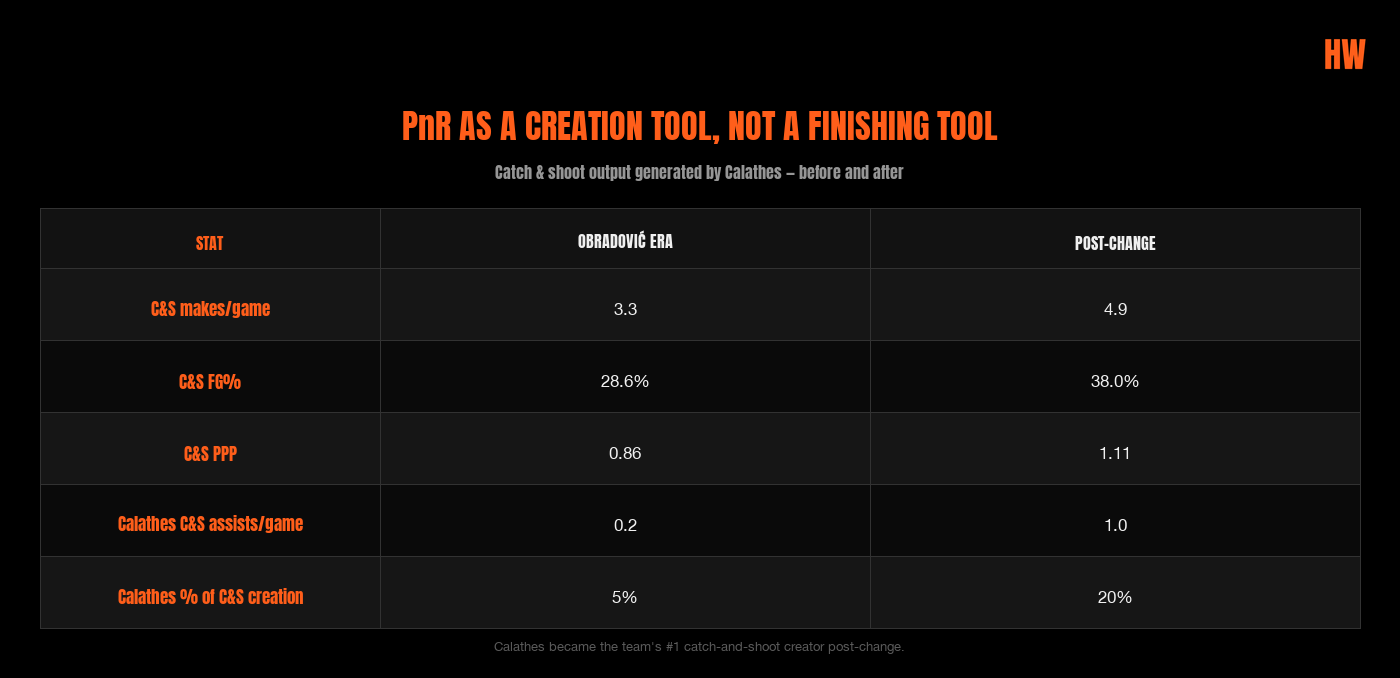
Calathes became the team's #1 catch-and-shoot creator post-Obradović. His PnR actions generated kick-outs that the shooters converted at elite rates. The PnR "efficiency drop" was the cost; the catch-and-shoot explosion was the payoff and it more than compensated (+0.25 PPP on +1.3 more attempts per game).
What the Three Environments Look Like Side by Side
We ran the same tactical analysis across all three environments. The two Partizan eras and Trinchieri's final season at Žalgiris to compare them directly.
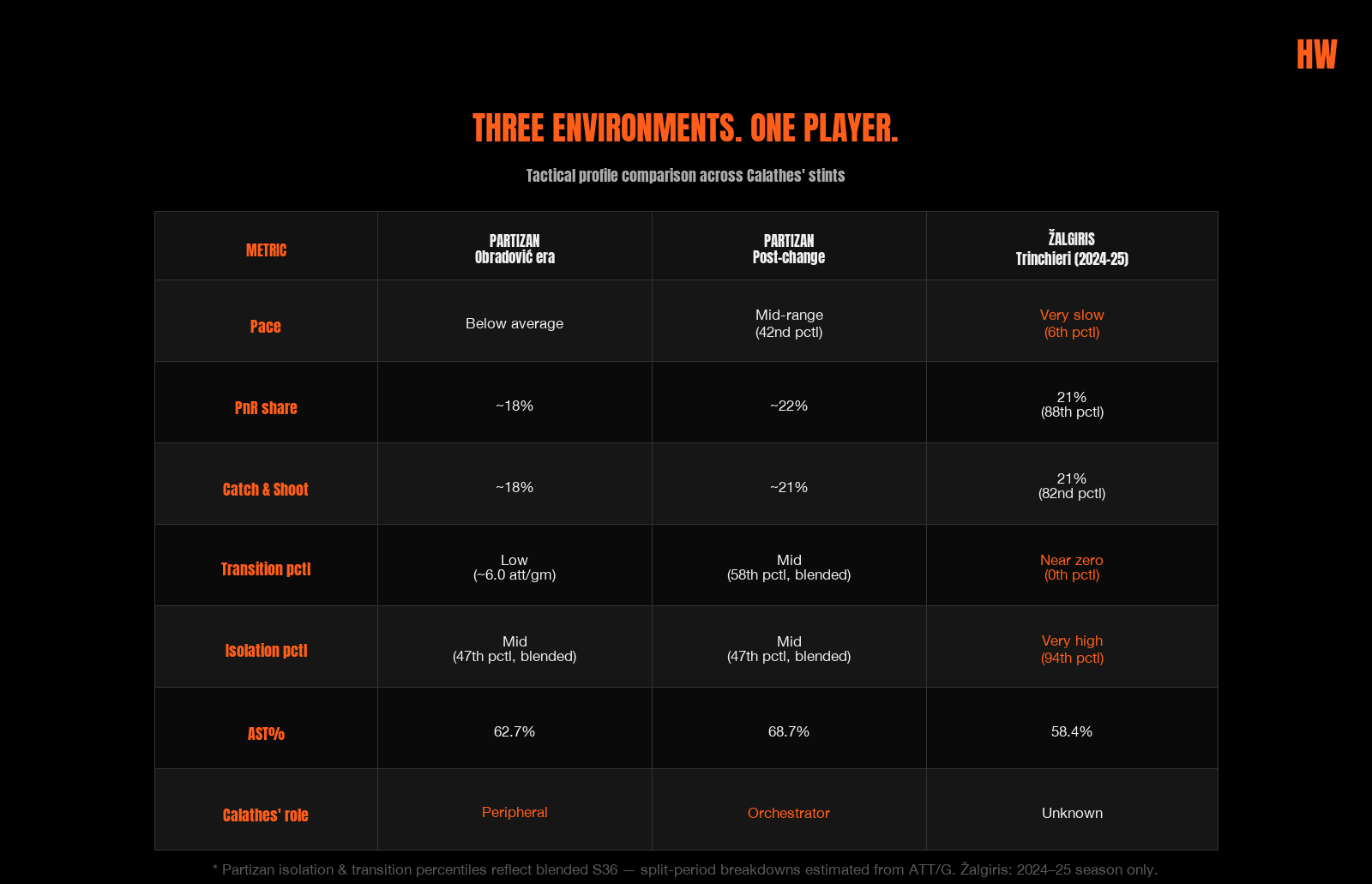
The table surfaces the structural difference immediately. The environment that unlocked Calathes was faster (mid-range pace post-change vs. 6th percentile at Žalgiris), more ball-movement oriented (AST% 68.7% vs. 58.4%), and used transition as a live weapon (58th percentile post-change vs. 0th percentile under Trinchieri). Isolation was mid-range at Partizan in both periods while under Trinchieri at Žalgiris it sat at the 94th percentile.
The one clear point of alignment: PnR volume. At Žalgiris, Trinchieri ran pick-and-roll at the 88th percentile, even higher than Partizan's post-change volume. That is the ingredient Calathes needs most. The question is whether everything surrounding it will allow him to use it the way he did in Belgrade.
WHAT DOES THIS MEAN FOR PAOK
The PnR fit is real and it is the foundation of the argument for this transfer making sense. Trinchieri builds his offenses around the pick-and-roll, and that is where Calathes does his best work. If he gets the orchestrator role in that scheme, running the action, reading the defense, creating the kick-out - the catch-and-shoot ecosystem that formed at Partizan post-change could replicate itself at PAOK.
But the context surrounding that PnR action is different from what unlocked him. The pace is not mid-range, it is one of the lowest in EuroLeague across two consecutive seasons. Transition was systematically eliminated by Trinchieri's second year at Žalgiris. And isolation volume at the 94th percentile is the structural opposite of what a pass-first playmaker needs to stay involved.
Under Obradović, Calathes was a square peg, a cerebral playmaker in a system that didn't need him. The post-change Partizan staff opened up the offense: faster pace, PnR as a creation tool, catch-and-shoot opportunities generated by his playmaking. He went from riding the bench of a losing team to being the engine of one that won nearly half its remaining games.
Trinchieri's PAOK will have the PnR volume. Whether it will have the pace, the ball movement, and the role clarity that made the Partizan revival possible is the question the pre-season will answer.
The +31.4 net rating swing at Partizan is not a narrative. It is a measurement of what Calathes produces when a system is genuinely built around him. PAOK will have a full season to find out whether Trinchieri's system is that environment.