THE PACE PUSHING BIGS
The Assist Before the Assist. Some big men don't finish the fast break. They create it.
Watch a defensive rebound and you see a big man catch the ball and turn. That moment, the two seconds that follow, will determine whether a transition opportunity materializes or disappears. If he holds, surveys the floor and waits for his teammates to set up, the opponent retreats. The advantage evaporates. If he fires immediately, if he finds the outlet before the defense has turned to run, the break is on.
The point guard gets credit for pushing the pace. The wing gets credit for the layup. The big man gets one defensive rebound in the box score and nothing else.
This piece is about the players the box score doesn't see.
Two signals, one question
To identify who genuinely creates transition, you need two measurements.
The first is straightforward: how often does a big personally appear in transition possessions? Personal possessions per game where he is the handler or the finisher. The second is more interesting: when this player is on the floor, does his team run more or less transition than usual?
That second signal, the team's transition frequency shift with the player on court versus off, captures something the first misses entirely. A player who is indirectly influencing transition. During one game, this is noise. During a whole season it isn’t. His own shot chart won't show many transition attempts. But every teammate's transition attempt happened because of him.
We mapped every qualifying Forward and Center in EuroLeague 2025-26 (minimum 15 games, minimum 15 minutes per game) across both signals. The result is four distinct Pace Archetypes.
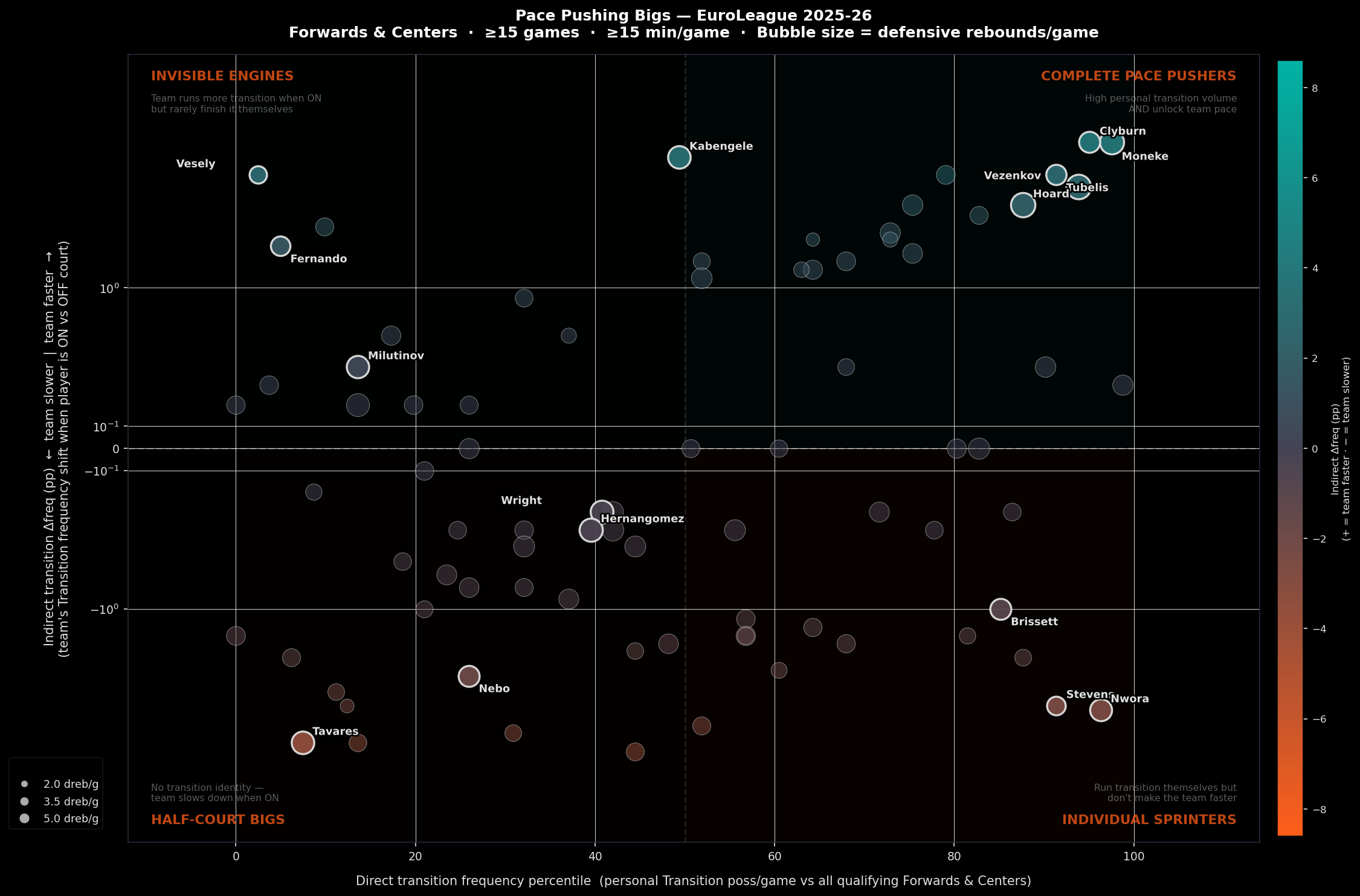
Chart examining direct vs. indirect transition frequency between big men in the Euroleague, for the 2025-2026 season
High personal volume and high team impact lands you in the top-right as a Complete Pace Pusher. Low personal volume but high team impact means you are an Invisible Engine, a player whose presence alone accelerates his team's offense. High personal volume with no team-level effect makes you an Individual Sprinter, a player who runs but doesn't unlock anyone else. Low everything places you in the Half-Court Bigs category. Your team does not run more when you are on the floor. If anything, it runs less.
Note the negative Y-axis. Some bigs don't just fail to push pace, they actively suppress it. When they are on the floor, transition frequency drops. That is not a coincidence of teammates or schedule. It is a consistent, repeatable effect across an entire season
THE THREE ROADS OF a defensive rebound
Before looking at the role breakdown, it helps to understand the three specific mechanisms that connect a defensive rebound to a transition basket.
The first is the Outlet Passer. He catches the board, reads the floor and fires to a cutting teammate before the defense can set. His direct transition numbers stay quiet. He is unlikely to finish the break himself. But his outlet rate, the share of his defensive rebounds that became a teammate's transition possession, tells you exactly what he contributes to pace.
The second is the Roadrunner. He grabs the board and goes himself. No intermediary, no read-and-deliver. He is the ball-handler, the pace-setter and the finisher all in one action. The break materializes because he chose to run.
The third is the Trailer. He doesn't initiate anything. He arrives late into a break already created by someone else, catches the ball in the paint with a step advantage and converts. His value is positional. A threat that defenses have to account for on every break, even when they are focused on stopping the primary ball-handler.
These three roles explain the pattern in the next chart. This chart show the Transition Sequencing Archetypes.
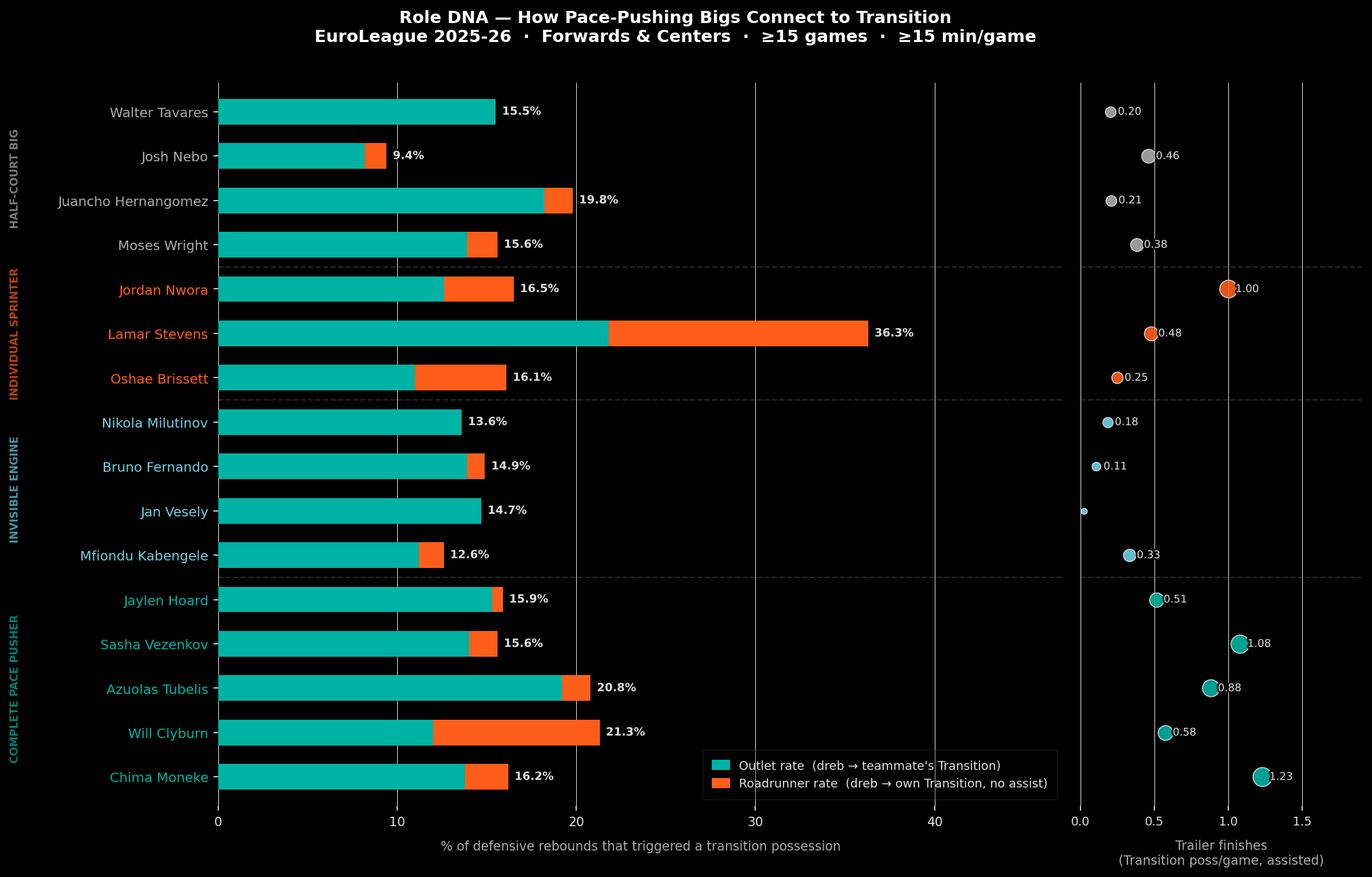
A look into the transition sequencing archetypes a big man can have
Lamar Stevens is the clearest Roadrunner in the dataset. His bar is almost entirely orange, 36.3% of his defensive rebounds end in a transition possession where he is the ball-handler. He grabs, turns and goes. No intermediary, no decision to make. The issue is that none of that translates into team-level pace. Stevens is an Individual Sprinter, his indirect number stays flat, because a Roadrunner who doesn't also outlet is running a one-man break. The defense loads up on him. The team doesn't benefit.
Compare that to Jan Vesely or Bruno Fernando. Their bars are almost entirely teal. Low roadrunner rate, high outlet rate. These are pure Outlet Passers. They rarely run themselves, but when they rebound, the ball is moving immediately to someone who can. That single decision, outlet versus hold, explains why their indirect numbers are positive while Stevens's is not.
The Trailers are the most underrated role in this chart, and they are easier to spot in the right panel. Chima Moneke leads with 1.23 assisted transition finishes per game. Sasha Vezenkov is at 1.08. Jordan Nwora at 1.00. These players are arriving late into breaks that others created, but they are arriving in dangerous positions. A six-foot-seven wing catching the ball in the paint off a break that a big man launched with an outlet pass is not a simple finish. For the defense, it is a nightmare to account for.
Moneke's full bar tells the complete story: wide teal segment, wide orange segment, and the largest trailer dot on the right. He outlets, he roadrunners when the lane opens, and he trails breaks that his teammates push. That combination, all three roles active, is what makes a Complete Pace Pusher different from everyone else in the chart.
DIFFERENCES Invisible by THE NAKED EYE
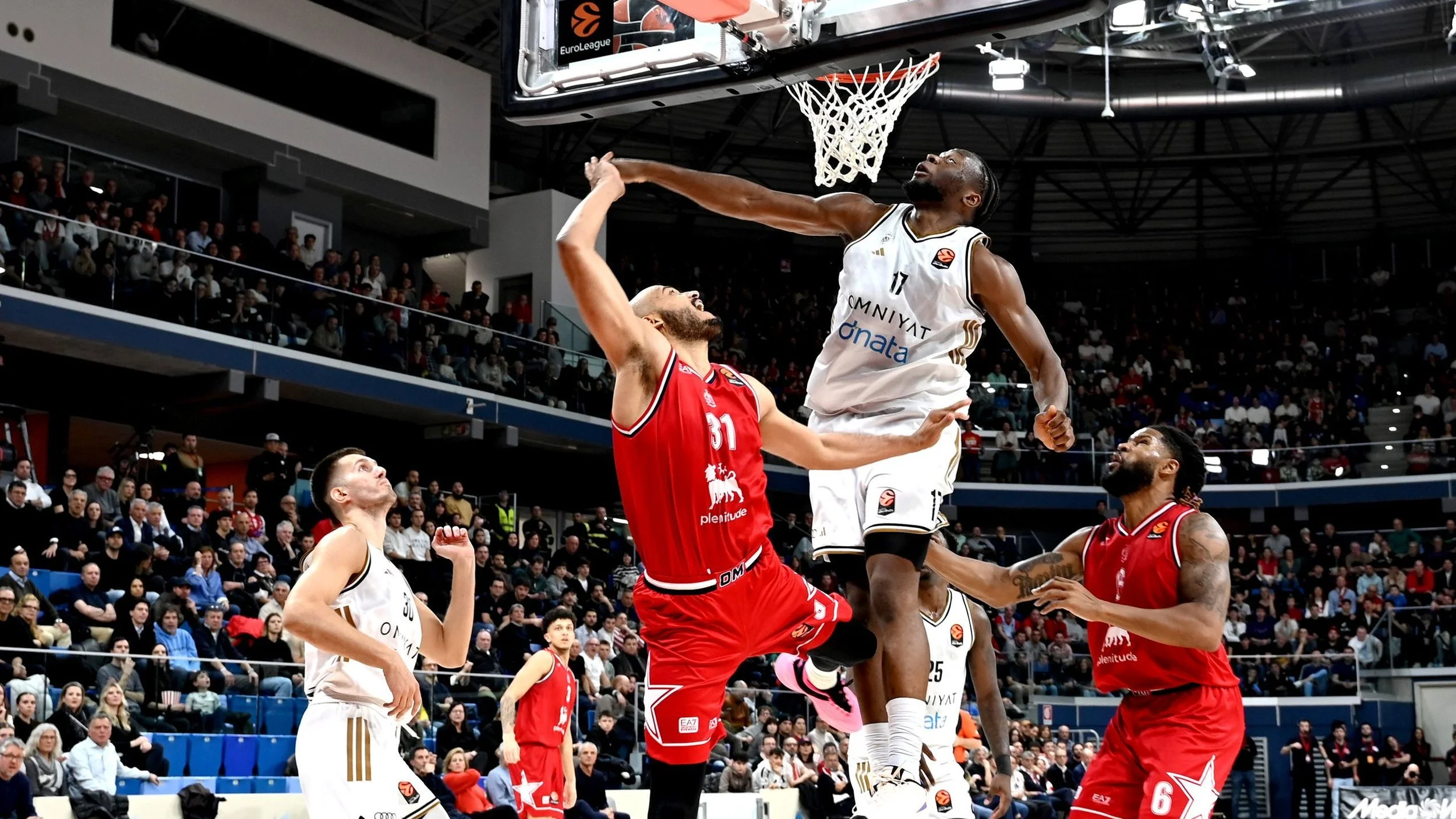
Mfiondu Kabengele against Olimpia Milano, season 2025-2026
Mfiondu Kabengele and Josh Nebo don't look different on film. Both are physical, athletic bigs who anchor their team's defensive rebound. Both are playing in EuroLeague at a high level. To a scout who watches the game without a stopwatch, they occupy the same general category.
The data disagrees.
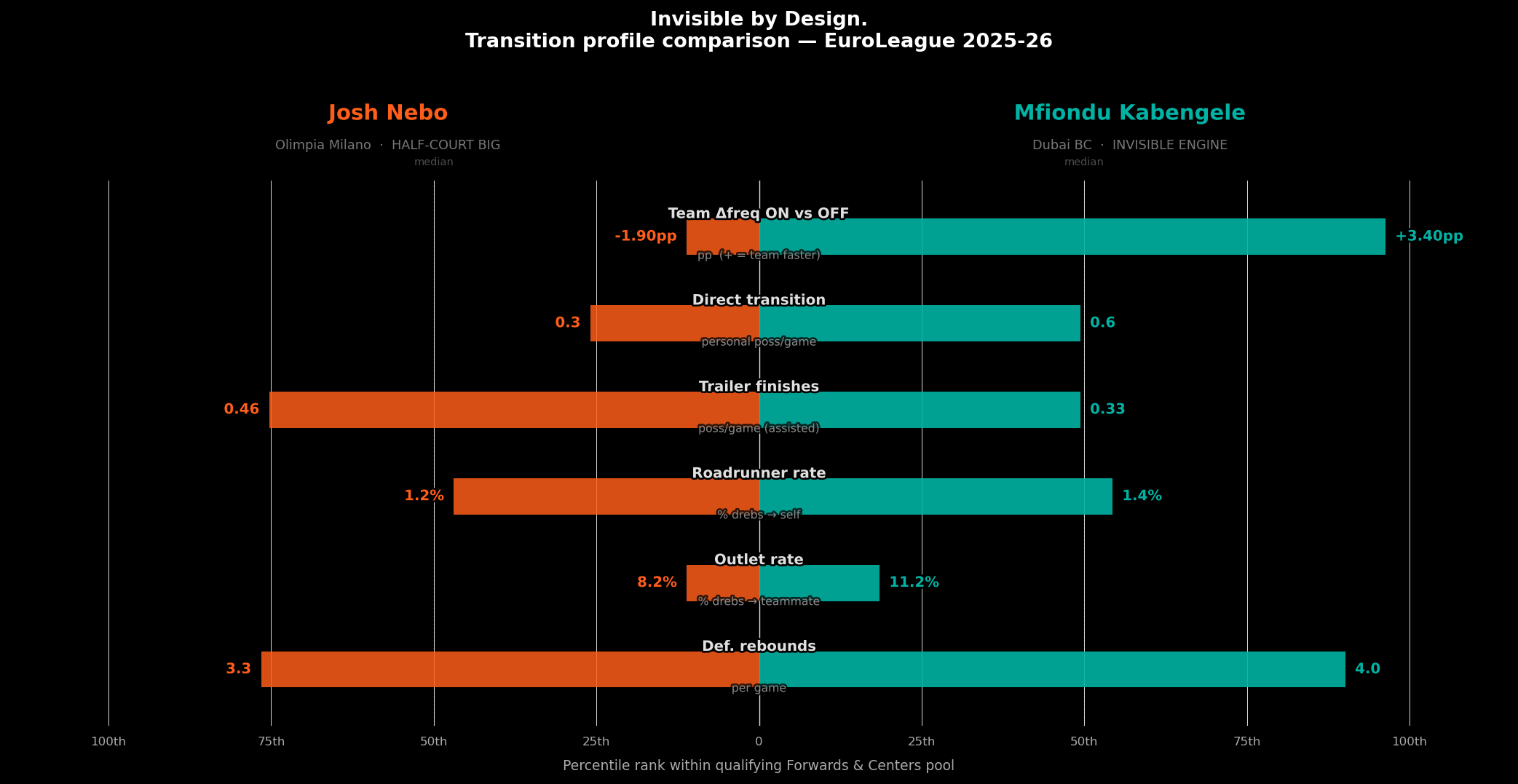
Mfiondu Kabengele vs. Josh Nebo - Transition profile comparison
Start from the top. Kabengele grabbed 144 defensive rebounds across 36 games this season. Nebo collected 86 across 26 games. The per-game rates are comparable, 4.0 versus 3.3, and the comparison is fair. Two big men with similar rebound profiles. Now look at outlet rate. Kabengele converts his defensive rebounds into teammate transition possessions at a meaningfully higher rate. When he grabs the ball, his team is more likely to run. When Nebo grabs the ball, the possession tends to go half-court.
The roadrunner and trailer rows are similarly muted for both players. Neither is a personal transition scorer. Neither grabs and goes on his own. This matters because it rules out the easy explanation. Kabengele's indirect impact is not coming from his own runs. He is creating pace for other people. The direct transition row confirms it. Both players show modest personal volume. Then the bottom row. Dubai BC's transition frequency shifts by +3.40 percentage points when Kabengele is on the floor. Olimpia Milano's shifts by minus 1.90 when Nebo plays. One big man is making his team faster. The other is making his team slower.
The box score lists both as defensive rebounders. One of them is also running his team's transition offense without ever touching the ball in transition.
What the box score misses
The outlet pass that starts a fast break will never appear in a stat line. The big who grabs a defensive rebound, pivots, reads the cutter and fires a 15-metre pass to a sprinting wing in stride gets one defensive rebound and nothing else. The wing who catches and scores gets the points. The assist goes to the passer. Nobody credits the origin.
The indirect transition signal is the closest measurement we have to that contribution. It shows up as a consistent team-level effect across a full season. Not a single game. Not a small sample. A repeatable pattern: some big men make their teams run, and some make their teams walk.
The ones who make their teams run rarely get recognized for it. These are the Invisible Engines of Euroleague for the season 2025-22026.